Reflections
Navigating the Transition: From Service to Design
As I prepare to transition from 25+ years of active duty service in the United States Coast Guard to the civilian sector, my professional trajectory is defined by specific proximal and distal goals. My proximal goal is to master the tools of the modern instructional designer—specifically the integration of AI-driven content generation and LMS architecture—to translate my technical background in Cybersecurity and engineering project management into educational assets. This immediate skill acquisition bridges the gap between my operational experience and pedagogical theory.
My distal goal is to establish a consultancy focused on high-stakes technical training, where I can lead organizations in modernizing their legacy training systems. By applying the discipline of military leadership to the agility of my "Zero Divisor" philosophy, I aim to disrupt stagnant learning models. Ultimately, I see myself not just as a creator of content, but as a strategic architect who uses instructional design to solve systemic organizational performance issues.
The Marketplace Demand for Agility: AI and Microlearning
The modern marketplace is no longer satisfied with static, hour-long e-learning modules; it demands agility and personalization. Two emerging trends driving this shift are Artificial Intelligence (AI) integration and mobile-first microlearning. As noted by Savage (2025), AI is shifting from a futuristic concept to a collaborative partner, automating data-driven tasks to allow designers to focus on strategy. This trend affects the field by requiring designers to become "editors" of AI-generated content rather than just authors, significantly speeding up the development cycle.
Simultaneously, the "busy workforce" demographic necessitates microlearning—short, focused bursts of content accessible on mobile devices. Stefaniak (2021) emphasizes that instructional solutions must respect the learner's environment; today, that environment is fragmented and mobile. For instructional designers, this means abandoning the "broadcast" style of long lectures in favor of conversation-first, bite-sized assets that solve immediate problems.
Integrity in the Age of Algorithms
In the field of instructional design, "integrity" is often synonymous with academic honesty, but in practice, it extends to the ethical representation of data and the learner's time. Aligning with the Canyon Center for Character Education competencies, specifically Integrity and Service, my work demonstrates a commitment to "truth-telling" in design. This means avoiding "dark patterns" that trick learners into engagement and instead designing transparent, user-centered experiences.
Honesty in my professional work is demonstrated by acknowledging the limitations of a training solution. As a "Zero Divisor," I believe that disrupting a broken system is an act of service. If a client requests training for a problem that is actually environmental (e.g., bad tools), integrity requires me to push back and recommend a non-instructional solution, rather than selling them a course that won't work. By serving the learner's actual needs rather than the client's perceived wants, I maintain the ethical standards essential to the profession.
The Sente Kinetic Mind: Designing with Initiative
In the strategy game of Go, Sente refers to the state of holding the initiative—forcing the environment to respond to your moves rather than the other way around. My professional philosophy, Sente Kinetic Mind, translates this concept into instructional design by rejecting the passive role of "order taker." Traditional design often operates in Gote (reacting), waiting for performance gaps to become critical failures before deploying a solution. A Kinetic Mind strategy is preemptive.
By applying the "Kinetic Mind" approach, I design systems that move at the speed of the learner's environment. This involves using predictive analysis to identify friction points and deploying performance support that meets the learner before the gap widens. This shift from reactive content creation to proactive system architecture ensures that the instructional solution controls the flow of performance, serving as a strategic asset rather than a corrective measure (Stefaniak, 2021).
The Neuro-Architecture of Learning: Optimizing Memory, Retention, and Transfer
The Mission: As instructional designers in high-consequence environments, we are not merely content creators; we are architects of the brain. To drive performance, we must align our systems with the biological realities of how the brain encodes, stores, and retrieves information. When we design against the brain's natural biology, we create friction; when we design with it, we achieve the "Kinetic Mind" state of seamless operational reflex.
The Mechanics of Memory: From Input to Archive
Memory is not a static recording but a dynamic reconstruction. The process follows a specific biological pipeline:
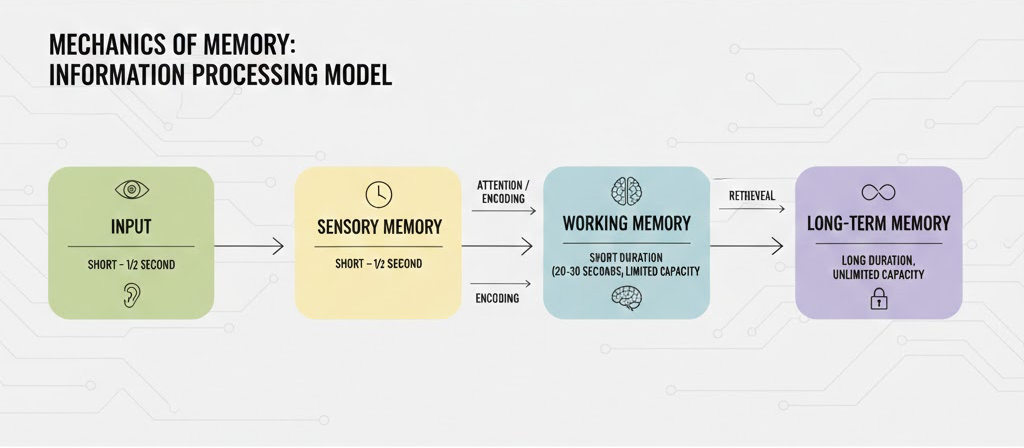
- Sensory Memory (The Filter): This is the brain's gatekeeper, bombarded by infinite stimuli (sight, sound, haptics). It lasts only milliseconds. If input is not immediately attended to, it is discarded.
- Working Memory (The Workbench): Also known as short-term memory, this is where conscious processing happens. It is a bottleneck, capable of holding only about 7 items at a time. If we overload this with cognitive noise, learning stops (Sousa, 2022).
- Long-Term Memory (The Archive): The ultimate goal. This includes declarative memory (facts/protocols) and procedural memory (skills/reflexes).
The Biological Reality: Memories are established through Long-Term Potentiation (LTP). When neurons fire together repeatedly, their synaptic connections physically thicken. Learning is a physical restructuring of the brain's hardware. Without this consolidation process, training is merely "exposure," not education.
Retention vs. Transfer: The Operational Imperative
Retention is the ability to preserve the neural trace over time—fighting the "forgetting curve." Transfer is the ability to retrieve that trace and apply it in a novel context (e.g., applying a classroom safety protocol during a live cyber-incident).
In my view, retention is the supply, but transfer is the logistics. You cannot have transfer without retention, but retention does not guarantee transfer. To bridge this gap, we must design for "near transfer" (simulations that mimic the job) and "far transfer" (principles applied to new problems). If the neural pathway is only associated with the classroom context, it will not fire in the field.
When the System Fails: Trauma and the "Hijacked" Brain
In high-stakes fields like the military or emergency response, we often train individuals carrying the weight of past trauma. It is critical to understand that trauma physically alters the brain's processing power.
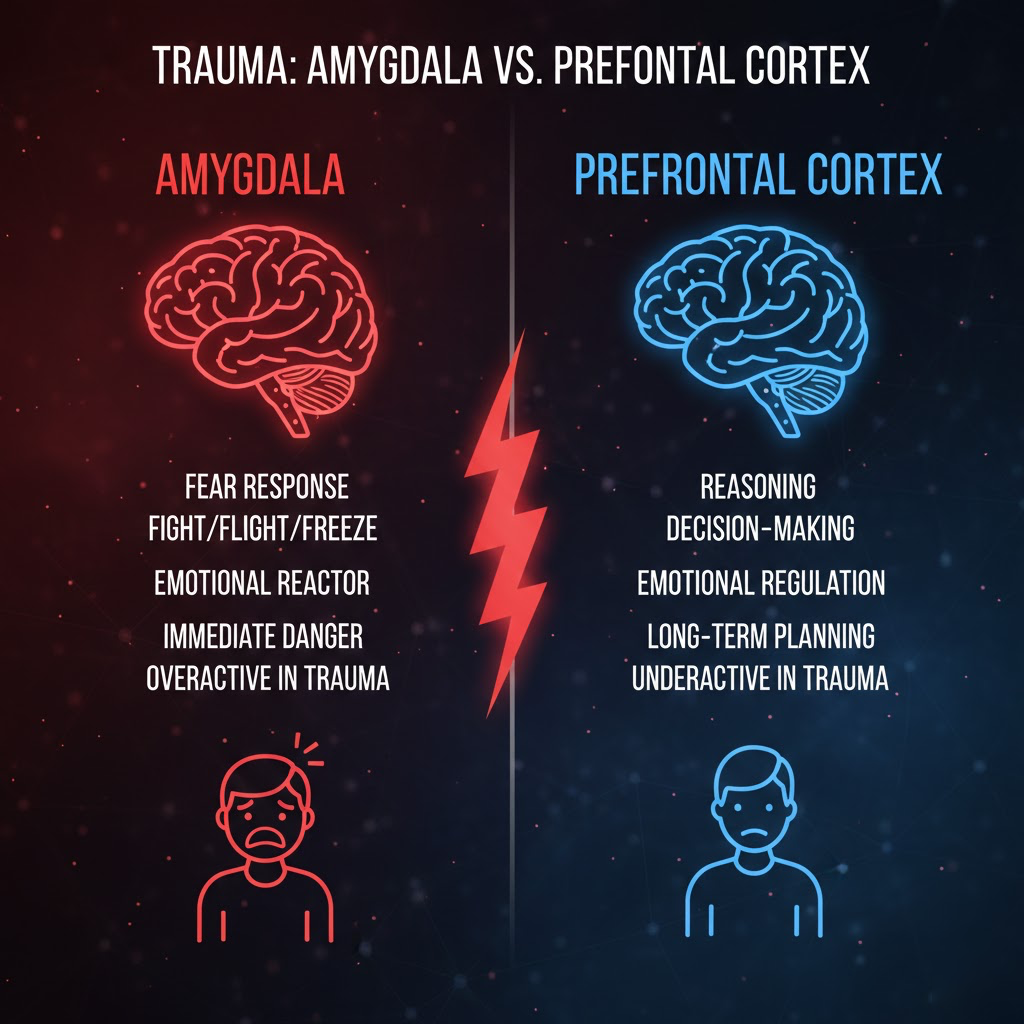
Under stress or triggered trauma, the Amygdala (threat detection) becomes hyperactive. It triggers a release of cortisol that effectively disconnects the Prefrontal Cortex (executive function) and inhibits the Hippocampus (memory formation). A learner in this state is biologically incapable of complex processing; they are in survival mode. "Toughness" cannot override this biological circuit; only safety can (National Institute for the Clinical Application of Behavioral Medicine [NICABM], n.d.).
Strategies for the Instructional Designer
To optimize this system, I employ three core strategies:
1. Dual Coding (Reducing Cognitive Load):
Strategy: Presenting visual models alongside verbal explanations simultaneously.
Application: The brain processes visual and verbal data in separate channels. By using both, we bypass the working memory bottleneck. For trauma-impacted learners, clear visual anchors provide a sense of predictability and safety, reducing the cognitive load required to "imagine" the concept (Sousa, 2022).
2. Spaced Micro-Learning (Securing Retention):
Strategy: Breaking "firehose" lectures into spaced, bite-sized intervals.
Application: This forces the brain to repeatedly retrieve and reconsolidate the memory trace, strengthening LTP. It prevents the burnout that triggers the amygdala hijack, keeping the learner in the optimal "challenge zone."
3. Psychological Safety as Scaffolding (Enabling Transfer):
Strategy: Establishing non-punitive, predictable routines in training simulations.
Application: By lowering the "affective filter," we keep the prefrontal cortex online. When a learner feels safe to fail during simulation, their brain remains plastic, allowing them to encode the complex decision-making skills needed for transfer to the real world (Riley & Terada, 2019).
ADDIE Teaches You to Evaluate Your Solution. Action Research Teaches You to Question It.
Most instructional designers enter the field with ADDIE as their foundation. Evaluate is the last phase — you measure whether the training worked, feed the findings back into the next iteration, and close the loop. Bagdy and Stefaniak (2025) describe this well: evaluation is fundamentally about stepping back to assess a program's design, delivery, and outcomes before making informed decisions about future iterations. It is a confirmatory process. You built something and you want to know if it performed.
Action research operates from a different orientation entirely. It treats the design and implementation process itself as a site of inquiry. The question shifts from "did it work?" to "what does the data reveal about the problem, the solution, and my own assumptions as the designer?" The practitioner becomes a researcher embedded in the work, not an evaluator standing outside of it.
That shift has practical consequences. When you are both the designer and the evaluator, your investment in the outcome stops being just a professional consideration, it becomes a methodological one. Confirmation bias does not merely become a risk at that point. Without deliberate safeguards, it becomes the default.
ADDIE gives you a process. Action research gives you a stance. Both matter. But only one of them asks you to turn the lens on yourself.
References
Bagdy, L. M., & Stefaniak, J. E. (2025). Evaluative practice in learning, design, and technology: Theory, process, and decision-making in context. Routledge. https://doi.org/10.4324/9781032701301-1
Savage, O. (2025, March 10). AI as a collaborative partner: Redefining roles in the workplace. The Learning Guild.
Stefaniak, J. E. (2021). Needs assessment for learning and performance: Theory, process, and practice. Routledge.
National Institute for the Clinical Application of Behavioral Medicine. (n.d.). How does neuroplasticity work? https://www.nicabm.com/brain-how-does-neuroplasticity-work/
Riley, H., & Terada, Y. (2019). Bringing science of learning into classrooms. Edutopia.
Sousa, D. A. (2022). How the brain learns (6th ed.). Corwin.